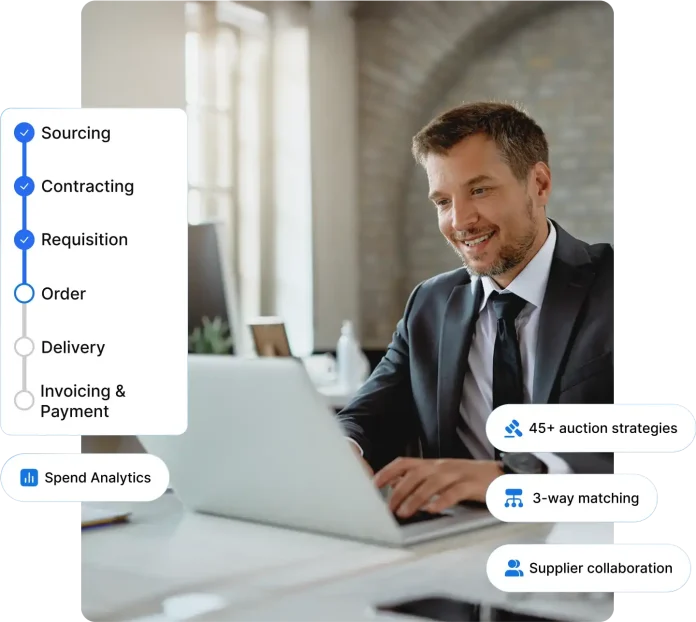

Procurement no longer has the purchase orders and payments as its exclusive property. It has become a strategic strength that leads to operational efficiency, cost reduction, and compliance. It is important to have the capability of sourcing, collaborating with suppliers, and managing payment workflow. This is where a source to pay solution will come into play, and all procurement functions are brought together under a smart digital ecosystem.
Nonetheless, it is important to evaluate the correct solution. It is not just about the brand name or interface but rather the extent to which the platform fits in the organization’s goals, processes and people.
The seven important considerations to make when selecting the appropriate system are listed below:
1. End-to-End Process Coverage
Any holistic procurement solution must address all the parts of the cycle, which include strategic sourcing and supplier onboarding, contract management, purchase order processing, and payments. With all these steps being on one platform, data will move smoothly, thus reducing manual errors and delays. The optimal system enables real-time access to spending trends, supplier performance, and compliance measures.
Such a thorough coverage also means that procurement departments will not need to change between various tools to reduce duplication and administrative expenses. Integrated flow of work enhances effective communication among the various departments, such as finance, operations, and logistics.
2. Scalability and Flexibility
There is no organization that does not change; it grows in its operations, changes markets, and business requirements change. This is why the issue of scalability is among the most essential when selecting a procurement solution. The elastic platform may be used to facilitate expansion, which could involve dealing with a larger supplier base, more than one currency, or regulation across geographies.
Scalable systems are constructed to take on new business units, highly flexible workflows, and new technologies without significant overhaul. The flexibility also goes to customization, where the enterprises get the freedom to customize the approval hierarchies, dashboards, and reporting formats to suit their requirements.
Besides, with organizations adopting sustainability and digital transformation efforts, scalability will lead to an easy adjustment to new policies or data analytics models. The outcome is a procurement operation that becomes dynamically scalable as the business grows, making it long-term efficient and value-producing without the necessity to replace the platforms so often or perform expensive overhaul procedures.
3. User Interaction and Integration
The richest platform is useless when it cannot be navigated by the end-users. An effective system must be user-friendly, attractive, and user-oriented. The software should be easy to use but effective for all the procurement teams, suppliers, and finance staff, as they all deal with the software in their own way.
When users have a good experience, more users will adopt the system quickly and reduce the need to train them. Processes are easy since they are guided by workflows, smart search, and real-time notification. Indicatively, the purchase requisitions and real-time approval notification can reduce cycle times significantly.
Employees tend to adopt a system that they find simple to use, and in this case, compliance and proper data capture will be achieved.
4. Connection with the Pre-existing Systems
Procurement does not work on its own. It is in contact with finance, supply chain, and inventory management systems. The best procure to pay platform should be integrated with the current ERP, CRM, and accounting systems.
Integration is important in that it will provide a flow of the right information between purchase requisitions and payments without duplication of data. This interconnectedness also assists in having one version of the truth between departments. As an example, supplier invoices may automatically update finance systems, enhance precision, and decrease the amount of manual tasks.
APIs and plug-ins are also provided, enabling new modules to be added without affecting the existing operations. This becomes possible due to the real-time exchange of data that results in enhanced forecasting, compliance, and budget control.
5. Supplier Cooperation and Openness
Supplier relationships are essential for procurement success. The strong platform must encourage collaborative work in both directions. Modern tools allow suppliers and buyers to communicate with each other in the same dashboards and via digital workspaces, instead of email or spreadsheets.
Transparency builds trust. Purchase orders, payment positions, and performance scores are available in real-time, allowing the suppliers to see them. This transparency will reduce misinterpretation and create accountability in both directions. Improved visibility also aids the procurement teams in tracking supplier risk, delivery performance, and compliance.
Furthermore, supplier innovation can be ensured through collaborative platforms, whereby suppliers can suggest alternative or cost reduction ideas using the system to do so. These partnerships stimulate each other to grow, hence being resilient in case of a market disruption. The greener and more transparent your supplier ecosystem is, the more trusting and sustainable your supply chain will be.
6. AI-Powered Insights and Analytics
In the modern data-driven environment, the procurement leaders have to transcend transactional management. The future of cost efficiencies and spend optimization is being redefined by advanced analytics and artificial intelligence to enable organizations to find cost efficiencies and spends. An intelligent solution uses such technologies to transform raw data into actionable information.
AI-based dashboards will have the ability to detect abnormalities automatically, predict demand, and suggest sourcing policies. Predictive analytics aids organisations to spot possible risks or saving chances in supply earlier than they take place.
Such insights can be used to make decisions ahead of time, enabling the procurement departments to negotiate more favorable contracts and optimize the workflow. In the long run, data intelligence will increase visibility, decrease maverick spending, and improve compliance.
7. Security, Compliance, and Support
Trust in procurement is based on data security and compliance. The platform selected should provide state-of-the-art encryption, access control, and audit trails to protect sensitive financial and supplier information. Transparency and accountability are guaranteed by the standards of local and international regulations.
In addition to technical protection, solid vendor support is crucial, as well. Maintenance after deployment, updates, and training will make sure that the system is kept in line with the business objectives. As your procurement landscape changes, you will have a reliable partner that will help in troubleshooting, configuration, and optimization.
There are also protections against fraud and policy violations, such as compliance capabilities, such as automated audit logs and approval hierarchies. Simply, a secure and properly supported platform will not only reduce risk but also will instill confidence among the stakeholders, which, in turn, will help organizations to concentrate on strategic growth, but not operational vulnerabilities.
Conclusion
The choice of a source-to-pay solution is not merely a software choice, but a strategic choice as it influences the manner in which your organization spends, cooperates, and develops. The right system incorporates people, processes, and information, and every purchase is made in alignment with business objectives and provides quantifiable value.
An efficient solution improves transparency, boosts vendor relationships, and leads to sustainability. In organizations that are willing to take the next level of procurement excellence, innovative digital solutions should be considered to discover unparalleled efficiency and control.
To discover cutting-edge platforms that empower procurement transformation and business agility, contact Procol, a trusted partner for smarter, data-driven procurement evolution.