
The human immune system is wonderful until it gets a little too excited. The same biological machinery that was designed to protect the body can sometimes misfire, attacking healthy tissues or fueling disease processes that are difficult to control. That uncomfortable reality is precisely why complement inhibitors are such a hot topic in modern medicine.
But to those outside of biotech or immunology, “complement inhibitors” can sound intimidatingly technical. But the core concept is surprisingly simple. These therapies focus on the complement pathway, a component of the immune system that plays a large role in inflammation, immunity and cellular cleanup. When this system is not functioning properly it can contribute to serious diseases involving blood disorders, kidney conditions, neurological problems and inflammatory damage.
Complement inhibitors are designed to block that damaging activity. What is particularly interesting about this area is that it combines state-of-the-art immune science with very practical clinical needs. Many of the diseases associated with complement dysfunction are rare, complex or historically hard to treat. These therapies are thus much more than scientific curiosity.
What Do Complement Inhibitors Actually Do?
The complement system is part of the body’s built in defense network. It involves identifying threats, activating immune responses and removing damaging material from circulation. Such process facilitates protection and recovery in a healthy environment. The problems come when the system is overactive or poorly regulated.
In some cases, complement activity may be harmful to healthy cells rather than protective. Such damage can lead to chronic inflammation, tissue injury, blood-related complications or organ dysfunction. Complement inhibitors act by blocking certain parts of the complement cascade that lead to unwanted immune activity.
Different biological entities are targeted by therapies. Some block proteins like C5, and newer approaches are testing other pathways and mechanisms in the wider complement network. Complement inhibitors are “precision brakes for an immune system moving too aggressively,” one immunology researcher said. It is a simple explanation, but it captures the therapeutic aim surprisingly well. Rather than broadly suppressing the immune system, these therapies are designed to intervene with greater specificity.
Rare diseases have driven interest
Much of the early momentum behind complement inhibitors has been in the treatment of rare diseases. Some severe disorders are directly associated with dysregulation of the complement system. Conditions such as paroxysmal nocturnal hemoglobinuria, atypical hemolytic uremic syndrome and certain immune mediated kidney diseases have become important treatment areas for complement targeted therapies.
Patients living with these conditions often have challenging treatment journeys. Unfortunately, delayed diagnosis, limited therapeutic options and chronic disease burdens are common experiences for many rare disorders. In this setting, targeted therapies can dramatically change expectations for therapy.
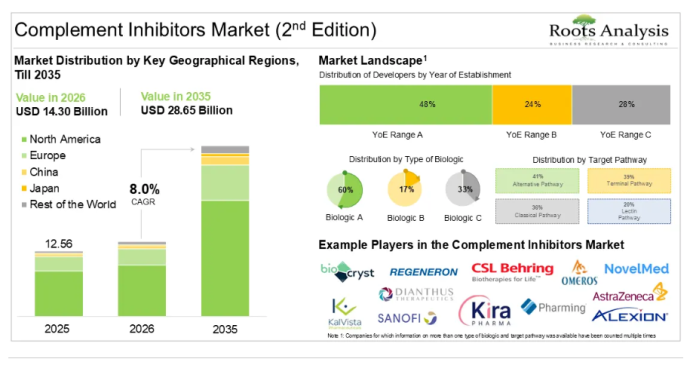
I recently came across Roots Analysis, and they said that “The global complement inhibitors market size, valued at USD 12.56 billion in 2025, is projected to reach USD 14.30 billion in 2026 and USD 28.65 billion by 2035, at a CAGR of 8% during the forecast period 2026 to 2035.” These numbers indicate increasing scientific and commercial confidence in this therapeutic category.
But the expansion is not just because companies see business opportunities. This is happening because a deeper understanding of immune biology is revealing new opportunities for diseases that previously had no highly targeted treatment strategies. ## Research is moving beyond conventional applications
Research Is Expanding Beyond Traditional Applications
The rapid evolution of the complement research landscape is one of the more interesting aspects of complement science. Early on, much attention was focused on a small group of rare diseases that are strongly associated with complement dysfunction. That emphasis is still relevant, but the field is gradually expanding.
Scientists are now exploring possible roles for complement modulation in other therapeutic areas. Kidney diseases continue to be an active area of research as some of the complement pathways appear to be highly associated with inflammatory injury of the kidney.
Neurological conditions are also becoming of interest. Scientists keep studying how immunity-related mechanisms, like complement activity, might influence neuroinflammation and neurological disease processes. Ophthalmology has joined in the game too.
Some retinal disorders appear to be associated with the behavior of the complement system, which opens therapeutic exploration that would have been less obvious years ago. This expanding range of applications helps explain why complement inhibitors continue to attract investment, partnerships and research attention. Science is getting broader, not narrower.
Innovation Is Driving the Next Generation of Therapies
The complement inhibitor field is not static. Drug developers are also actively looking at newer approaches involving alternative targets, improved dosing profiles and more convenient treatment formats. Sometimes the way you administer is more important than people realize.
Patients and clinicians often favor therapies that reduce treatment burden, simplify scheduling, or offer greater flexibility. So, companies are investing in formulation and delivery methods that would provide better patient experience. There is also increasing interest in oral therapies and next generation inhibitors that target different parts of the complement cascade. The field is competitive and this is leading to innovation.
Usually this is positive for the ecosystem, as it stimulates scientific progress and expands the therapeutic possibilities. One of the pharmaceutical experts recently stated, “the future of complement therapy may come down to how precisely developers can tailor pathway intervention.” That observation also appears particularly relevant as researchers are discovering more about the complexity of the immune system.
Challenges Still Shape the Field
Despite the strong scientific momentum, complement inhibitors still face important challenges. Cost is still one of the most talked about questions. Many advanced immune targeted therapies are expensive due to complex development pathways, biologic manufacturing needs and specialized clinical programs. Access, reimbursement and long-term affordability are questions that healthcare systems, insurers and policymakers are grappling with.
Clinical complexity also impedes access. Rarely is immune modulation simple. “Researchers need to weigh the potential benefit of therapy against any potential safety concerns, such as risks associated with infection or unintended immune consequences. Another pragmatic challenge is diagnosing. Rapid identification of some diseases with complement dysfunction can be challenging, which may result in delay in patient identification and initiation of treatment.
Regulatory expectations are tough too – particularly in the treatment of rare diseases where the populations in clinical trials can be quite small. These challenges do not diminish the promise of the field, but they do define the path ahead for innovation.
The Human Aspect of Complement Therapy
When talking about complement inhibitors it is easy to get lost in pathway diagrams, protein targets and clinical terminology. But behind all that science are patients struggling with complex medical realities. For those with rare blood disorders, inflammatory kidney diseases or complement related immune conditions, therapeutic advances can influence them more than just lab results.
They can impact energy, daily functioning, treatment plans, course of disease, and overall quality of life. What matters is the human factor. Patients with rare immune conditions can spend years trying to find answers, specialists and effective management. “Targeted therapies offer something meaningful in that context: the possibility of more precise treatment that is aligned with disease biology.
It’s one reason why the field continues to draw so much attention from researchers, clinicians, advocacy groups and health care organizations.
Conclusion
Complement inhibitors are an increasingly important area of modern medicine, targeting diseases that result from complex immune system dysfunction. These therapies target specific components of the complement pathway and aim to deliver more precise intervention in conditions that can be severe, chronic and difficult to treat.
The field is moving forward thanks to research, innovation, and increasing clinical awareness. New work in nephrology, neurology and ophthalmology is broadening the therapeutic landscape, while rare diseases remain at the heart of the story. Cost, diagnosis, regulatory expectations and the complexities of the immune system remain important challenges. Still, the broad direction appears clear.
Complement inhibitors are becoming more than a niche in immunology They are part of a wider move to targeted medicine where better understanding of biological pathways can lead to more targeted and potentially more effective care for patient.