
India, a country of breathtaking diversity, is renowned for its festivals, which are as colorful and diverse as the nation itself. Every community, church, state, and area celebrates its own festivals with its own customs, music, rituals, and zeal. All of them are vibrant, engaging, and bursting with vitality, whether they are spiritual, seasonal, or truly cultural. Indian festivals are particularly special because of their capacity to unite communities in joy and foster a connection to one’s history. Experiencing these festivities gives tourists and culture vultures a glimpse into India’s essence.
Numerous festivals that illuminate cities, villages, and hearts are scattered throughout India’s enormous length and breadth. There’s a good probability that a festival is taking held somewhere in the nation when you visit. Indian festivals are as much about storytelling as they are about entertainment, from traditional customs to contemporary interpretations, from tribal dances to classical music.
Diwali, often known as the festival of lights, is one of India’s most recognizable holidays. Diwali, which is observed nationwide by Hindus, Sikhs, and Jains, represents the victory of good over evil and light over darkness. Whole cities and towns are changed by this celebration. The smell of sweets and the sound of fireworks fill the air as houses are cleaned and decked out with oil lamps and fairy lights. It’s a really happy occasion, but it’s also profoundly spiritual, with roots in mythology and family customs. The marketplaces in Jaipur are ablaze with a golden glow, while the ghats of the Ganges are illuminated by hundreds of diyas in Varanasi. Diwali is more than simply a festival; it’s a five-day celebration of light, warmth, and beauty.
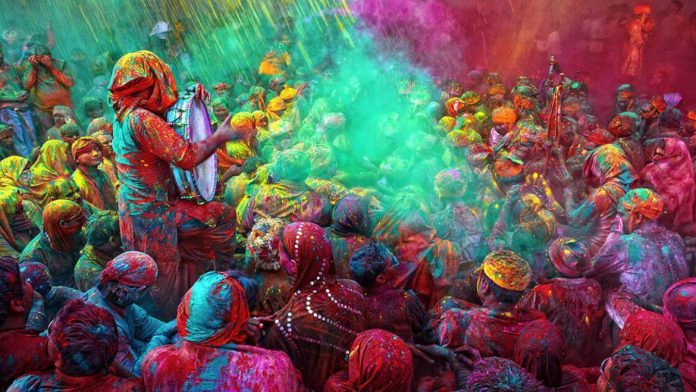
Holi, the celebration of colors, is as stunning but has a different tone. Perhaps the most recognizable Indian celebration in terms of appearance is Holi, which takes place in the spring. As people dance to drums, fling colored powder (gulal) at one another, and temporarily forget social boundaries, the streets turn into battlegrounds of color. The atmosphere is lighthearted, jovial, and joyous. Holi is celebrated with unparalleled fervor and cultural richness in locations such as Mathura and Vrindavan, where Lord Krishna is thought to have resided. There are processions, music, temple rites, and even a women’s ritual called Lathmar Holi, in which women reenact legendary stories by hitting males with sticks. In addition to providing a cultural experience, Holi gives visitors a sense of freedom when laughter is heard above words and strangers become friends.
India’s cultural diversity extends beyond its well-known holidays. The Hornbill Festival in Nagaland, for instance, is a colorful exhibition of tribal customs, cuisine, crafts, and folk music in the northeastern regions. All of Nagaland’s tribes come together for a ten-day celebration of their culture in December. There are rock concerts, bamboo dances, traditional sports, and feathered headdresses—all of which combine traditional practices with contemporary manifestations. Anyone interested in India’s frequently disregarded tribal cultures will find it to be an enlightening experience. Hornbill is a celebration of identity, resiliency, and solidarity, in contrast to the more religious celebrations.
The largest and most cherished festival is Onam, which takes place in the southern state of Kerala. Onam, which has its roots in the harvest spirit and the legend of King Mahabali, unites people from all walks of life in a common pride and delight. The multi-course vegetarian supper known as Onasadya, which is served on banana leaves, is the centerpiece of Onam. In addition, there are Kathakali performances, flower rangolis, boat races, and traditional dances like Thiruvathira. India’s agrarian heritage, love of hospitality, and emphasis on elegance and beauty in all facets of life are all reflected in Onam. When you travel to Kerala during Onam, you are greeted as a guest of the culture itself rather than as a tourist.
Durga Puja is an artistic revolution in West Bengal, not only a religious festival. Durga Puja, which takes place in October, turns Kolkata into a living museum. Every neighborhood has temporary constructions known as pandals, each with a distinct theme that frequently combines mythology with architecture, social criticism, or international art. The goddess Durga’s idols are lovingly and painstakingly created by hand. Street food, music, performances, and a noticeable bustle are all there day and night. The festival’s emotional high point occurs on the last day, when the idols are submerged in waterways. Durga Puja is a feast for the senses, when community becomes family and devotion meets design.
The Pushkar Camel Fair in Rajasthan provides an alternative form of cultural understanding. What started out as a livestock trade event has developed into one of India’s most well-known cultural celebrations. The fair, which takes place in the desert town of Pushkar, offers a flurry of colorful Rajasthani culture along with camel races, folk performances, and hot air balloon rides. Traditional wrestling, turban tying, and the longest mustache contest are among the contests. An atmosphere of celebration and surrealism is created by the dunes, the holy Pushkar lake, and the pulsating sounds of dhol drums. The vast desert sky is the ideal environment for tradition to flourish there.
Further illustrating India’s religious plurality, Eid is observed nationwide with equal majesty. Eid-al-Fitr and Eid-al-Adha are highly spiritual holidays for Muslims that are celebrated with feasting, prayer, and almsgiving. Special marketplaces, neighborhood get-togethers, and mouthwatering cuisine, ranging from biryani to sheer korma, bring cities like Lucknow, Hyderabad, and Delhi to life. In India’s multicultural society, where neighbors of all faiths frequently participate in the celebrations, share meals, and send each other well wishes, Eid is unique.
Another cultural festival with close ties to agriculture and the seasons is Bihu in Assam. The farming calendar is divided into three Bihus, which are Kongali, Bhogali, and Rongali. In April, Rongali Bihu is at its happiest. It honors joy, fertility, and spring. Folk songs about love, rain, and rebirth are sung, people dress traditionally, and the lively Bihu dance is performed. Bihu is about a profound connection to the land, the seasons, and the cycles of life; it’s not simply about tradition.
The Hemis Festival offers a striking contrast to Ladakh’s frigid landscapes. It honors Guru Padmasambhava, the spiritual guide who introduced Buddhism to the Himalayas, and is held in the Hemis Monastery. Monks conduct vibrant masked dances throughout the event, signifying the victory of good over evil. An enduring aura is produced by the rugged terrain, the resonant chanting, and the spiritual tranquility. Time slows down and every movement has purpose at Hemis, which is both a cultural event and a spiritual immersion.
In January, Tamil Nadu hosts a four-day harvest festival called Pongal, which offers its own splendor. Pots overflow with boiling rice and milk, homes are adorned with kolams (rice flour patterns), and thanks are given to the sun, animals, and the natural world. Simple things can be joyful, and routines can be revered. Pongal demonstrates how Indian festivities frequently have intellectual and agricultural foundations, fusing cosmic symbolism with ordinary life.
Baisakhi commemorates the harvest of rabi crops and the Punjabi new year in Punjab. For Sikhs, it also has great significance as a celebration of the Khalsa’s founding. Bright bhangra and giddha dances, fairs, processions, and special prayers in gurudwaras are all part of the festival’s celebration. Baisakhi is known for its vibrant costumes, lively music, and golden meadows. It is a celebration that captures the vivacity and fortitude of the Punjabi soul.
India’s cultural festivals transcend language, geography, and religion. They are a reflection of the nation’s various identities and ongoing customs. Every festival is a different manifestation of faith, community, and art, whether it’s the tranquil boat races of Kerala, the magnificent Ganesh Chaturthi processions in Mumbai, the tribal Kumbh Melas, or the Sikh Nagar Kirtans.
There is more to these celebrations than merely taking in the customs and entertainment. It’s about stepping into a world where your senses are overwhelmed by color and sound, time seems to slow down, and you share a plate of food or a prayer with strangers. The spirit is warm, giving, and collective. One gets the impression that they are a part of something ageless and bigger. More than just a chance to take pictures, India’s traditional festivals give visitors a unique, unvarnished look at people celebrating.
What’s maybe most unique is how Indian festivities, no matter how large or little, are yet incredibly inclusive and deeply personal. They respect customs while keeping up with the times. They unite entire communities, families, and neighbors. They serve as a reminder of the diversity of human expression as well as the straightforward delight of gathering.