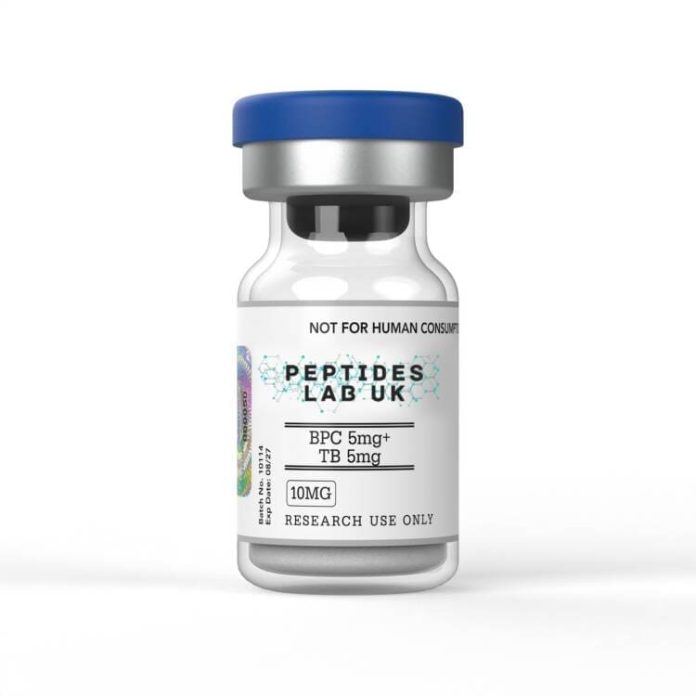

The BPC 157 TB500 co-formulation combines two structurally distinct research peptides in a single vial: BPC-157, a cytoprotective pentadecapeptide derived from a human gastric juice protective protein, and the TB-500 active fragment, a synthetic sequence representing the actin-binding domain of Thymosin Beta-4. Each compound has been studied independently for effects on angiogenesis, cell migration and soft tissue remodelling signalling, acting through partially overlapping but mechanistically distinct pathways. Within laboratory research, the bpc 157 tb500 combination is used as a tool for studying how these two pathways intersect in cell culture and animal-model systems investigating tissue-repair signalling.
What Is the BPC 157 TB500 Blend?
BPC-157 consists of a 15-amino-acid sequence, Gly-Glu-Pro-Pro-Pro-Gly-Lys-Pro-Ala-Asp-Asp-Ala-Gly-Leu-Val, with a molecular weight of approximately 1,419 Da, derived from a longer parent protein identified in human gastric juice. It is notable in the research literature for its stability across a wide pH range, including strongly acidic conditions, a property distinguishing it from many other short peptide sequences. TB-500 corresponds to the Ac-LKKTETQ sequence, residues 17 to 23 of the 43-amino-acid Thymosin Beta-4 protein, with a molecular weight of approximately 889 Da, and represents the principal actin-binding motif of the parent molecule, responsible for sequestering monomeric G-actin and regulating the pool available for polymerisation into filamentous actin.
The rationale for co-formulating these two compounds in a single research vial reflects their distinct but complementary cellular targets. BPC-157 research has focused heavily on angiogenic signalling through VEGFR2 receptor activation and modulation of the nitric oxide system, while TB-500 research has focused on actin cytoskeletal dynamics and the cell-migration machinery that depends on regulated actin polymerisation. Because tissue repair in vivo requires both new blood vessel formation and coordinated cell migration into an injury site, researchers have proposed that studying these two peptides in combination may offer insight into how angiogenic and cytoskeletal signalling pathways interact during soft tissue remodelling, even though each compound has traditionally been studied as an independent research tool.
It is important for researchers to understand that BPC-157 and TB-500 have substantially different volumes of independent research behind them, and that formal co-administration studies examining the two compounds together are considerably less common in the published literature than studies examining each compound in isolation. Much of the rationale for combination research is therefore mechanistic, based on the largely non-overlapping signalling pathways each compound is reported to engage, rather than derived from a large existing body of combination-specific trial data. Researchers designing comparative protocols should treat single-compound and combination findings as distinct evidence bases rather than assuming that individual-compound effects simply sum when the two peptides are studied together.
Synergistic Mechanism of Action
BPC-157 and the TB-500 fragment engage largely distinct primary mechanisms that researchers have proposed may act in a complementary fashion within tissue-repair signalling models. BPC-157’s best-characterised mechanism is upregulation and internalisation of vascular endothelial growth factor receptor 2 (VEGFR2) in endothelial cells, activating the downstream VEGFR2-Akt-eNOS signalling cascade. This pathway has been associated with increased endothelial tube formation in vitro and accelerated blood flow recovery in rat hind-limb ischemia models, with the angiogenic effect shown to be blockable using dynasore, a pharmacological inhibitor of receptor endocytosis, supporting a receptor-internalisation-dependent mechanism specific to BPC-157.
The TB-500 active fragment, by contrast, acts primarily through sequestration of monomeric G-actin via its LKKTETQ motif, maintaining a portion of the cellular actin pool in a polymerisation-incompetent state until cellular signalling triggers its release. This actin-sequestering activity is understood to regulate the formation of lamellipodia and filopodia, the actin-rich structures that drive directional cell migration, a mechanism entirely distinct from BPC-157’s receptor-mediated angiogenic signalling. Structural work resolving the actin-binding interface has confirmed that this motif caps both ends of the actin monomer, preventing incorporation into growing filaments until the cell’s signalling machinery permits polymerisation to proceed.
Both compounds have also been independently linked to focal adhesion kinase (FAK) signalling, though through different proposed routes. BPC-157 research using tendon fibroblast cultures has reported activation of the FAK-paxillin pathway associated with cell migration, alongside upregulation of growth hormone receptor expression in the same cell type. The Thymosin Beta-4 literature separately describes the actin-binding domain as the major cell-adhesion site on the full-length protein, with adhesion mediated through this site blockable using the isolated fragment itself, indicating that both compounds converge on adhesion- and migration-related signalling despite acting through structurally distinct upstream mechanisms, angiogenic receptor engagement for BPC-157 and cytoskeletal actin regulation for the TB-500 fragment.
Nitric oxide (NO) pathway interaction has been documented specifically for BPC-157, with research reporting that the peptide modulates NO system activity in a manner that appears to counteract both excessive vasoconstriction and excessive vasodilation depending on tissue context, a bidirectional effect proposed as a contributing mechanism to its broad activity across different injury models. This NO-modulating activity has not been established as a primary mechanism for the TB-500 fragment, whose research literature instead emphasises the actin-sequestration and laminin-5 interaction pathways relevant to epithelial and endothelial cell migration. Extracellular matrix synthesis signalling has been reported for BPC-157 in tendon and muscle repair models, where histological assessment has shown more organised collagen fibre deposition in treated tissue relative to controls, while TB-500 research has instead emphasised matrix interaction through the laminin-5 basement membrane component relevant to epithelial cell migration rather than collagen synthesis directly. Researchers combining these two compounds in cell-culture or animal-model protocols should therefore expect to observe effects attributable to two mechanistically separate but potentially complementary signalling axes, rather than a single unified pathway.
What the Research Shows
The foundational angiogenesis mechanism for BPC-157 was characterised using human vascular endothelial cell culture combined with a rat hind-limb ischemia model, which reported VEGFR2 upregulation, receptor internalisation and activation of the downstream Akt-eNOS signalling cascade, with the pro-angiogenic effect pharmacologically blocked at the level of receptor internalisation using dynasore (BPC-157 VEGFR2 activation study).
The foundational tendon study for BPC-157 examined complete transection of the Achilles tendon in rats, reporting improved biomechanical outcomes, including increased load to failure and Young’s modulus of elasticity, alongside superior histological organisation of collagen and fibroblasts in BPC-157-treated animals compared with controls, with a companion in-vitro assay reporting that BPC-157 directly stimulated tendocyte proliferation (BPC-157 Achilles tendon transection study).
For the TB-500 active fragment, foundational structural and mechanistic characterisation identified the seven-amino-acid LKKTETQ region as the major cell-adhesion site on Thymosin Beta-4, demonstrating that adhesion mediated through this site could be blocked using the isolated peptide, confirming its essential role in angiogenic activity in endothelial and aortic ring sprouting assays (Thymosin Beta-4 actin-binding site study).
A separate BPC-157 muscle-healing study examined complete transection of the quadriceps muscle in rats, reporting that systemic BPC-157 administration induced healing of an injury that does not spontaneously resolve in this model, with functional restoration maintained across a 72-day observation period, illustrating BPC-157’s activity across multiple soft tissue types beyond tendon alone.
Researchers should note that the great majority of the published preclinical literature for both compounds addresses each peptide independently rather than in combination, and that BPC-157 research in particular originates predominantly from a single research group based at the University of Zagreb, a concentration of authorship relevant to appraising the overall evidence base for both single-compound and combination research protocols.
Research Applications
Within laboratory settings, the BPC 157 TB500 combination is used across several established research contexts that draw on the complementary mechanisms of each compound. Tendon fibroblast outgrowth assays represent one application, in which researchers examine explant culture outgrowth and migration in response to either compound individually or in combination, building on BPC-157’s documented effects on tendon fibroblast FAK-paxillin signalling and TB-500’s actin-sequestration-dependent effects on cell migration. Endothelial tubulogenesis protocols are used to assess angiogenic potential, an application particularly relevant to BPC-157’s VEGFR2-mediated mechanism, though researchers studying the combination may also examine whether TB-500’s actin-regulatory activity influences the cytoskeletal remodelling required for endothelial tube formation downstream of angiogenic receptor signalling.
Joint tissue cell culture protocols, examining synovial fibroblasts, chondrocytes or ligament-derived cells, provide a further context in which researchers can compare responses to each compound independently and in combination, given that both BPC-157 and TB-500 have independently documented activity in connective tissue models. Wound repair modelling, typically using scratch-wound or transwell migration assay formats in dermal or endothelial cell lines, allows researchers to quantify directional cell movement, a functional readout linked to both BPC-157’s angiogenic signalling and TB-500’s actin-sequestration mechanism. When selecting a certified BPC-157 and TB-500 blend for cell migration or tissue interaction assays, researchers should confirm that both peptide sequences are independently verified in the supplied documentation, since combination products require analytical confirmation of each component rather than a single aggregate purity figure.
Comparative pharmacology work using each compound independently alongside the combination formulation allows researchers to distinguish additive from potentially synergistic effects in migration, proliferation or angiogenesis assays, an experimental design consideration relevant to interpreting any combination-specific findings against the more extensive single-compound literature for each peptide.
Purity, Storage and Handling
Research-grade bpc 157 tb500 combination material should be accompanied by a certificate of analysis confirming purity by HPLC for each individual peptide sequence, typically at or above 98 percent, together with mass spectrometry verification confirming the correct molecular identity of both the 15-amino-acid BPC-157 sequence and the acetylated seven-amino-acid TB-500 fragment. Because this is a dual-peptide product, analytical documentation should specify purity and identity data for each component separately rather than providing only a combined or generic specification. When evaluating high-purity bpc 157 tb500 combination vials for research, UK laboratories must confirm that mass spectrometry verifies both sequences independently, since degradation or synthesis error in either component could compromise interpretation of combination assay results.
Lyophilised combination product should be stored at -20°C, protected from light and moisture, in order to preserve the integrity of both peptide sequences prior to reconstitution. Co-reconstitution stability is a particular consideration for dual-peptide vials, since BPC-157’s reported stability across a wide pH range and TB-500’s more standard peptide stability profile may not have identical optimal buffer conditions; researchers should follow the specific reconstitution guidance provided with the combination product rather than assuming that conditions optimised for either peptide alone are directly transferable. Once reconstituted, the combined solution should be refrigerated at 2-8°C, used within the supplier’s stated stability window, and protected from repeated freeze-thaw cycling through appropriate aliquoting, since both peptide components remain susceptible to degradation through oxidation and hydrolysis during extended handling.
Frequently Asked Questions
Why are BPC-157 and TB-500 combined in a single research vial?
The two peptides engage largely distinct mechanisms, BPC-157 through VEGFR2-mediated angiogenic signalling and TB-500 through G-actin sequestration affecting cell migration, and researchers have proposed studying them together to examine how angiogenic and cytoskeletal signalling pathways may interact during soft tissue remodelling in cell culture and animal-model systems.
Is there extensive published research specifically on the BPC-157 and TB-500 combination?
Formal co-administration studies examining both compounds together are considerably less common in the published literature than studies examining each peptide independently. Most of the mechanistic rationale for combination research is derived from the largely non-overlapping single-compound literature rather than a large existing combination-specific evidence base.
How should a dual-peptide vial be verified for purity before use?
Researchers should request a certificate of analysis confirming HPLC purity of 98 percent or higher and mass spectrometry confirmation for each peptide sequence independently, since combination products require verification of both the BPC-157 and TB-500 components separately rather than a single combined specification.
Does reconstituting BPC-157 and TB-500 together require different handling than either peptide alone?
Co-reconstitution stability depends on selecting buffer conditions suitable for both peptides, since their individual stability profiles are not identical. Researchers should follow the specific guidance supplied with the combination product rather than assuming single-compound reconstitution protocols apply directly.
BPC 157 TB500, as supplied by Peptides Lab UK and comparable UK research suppliers, is intended strictly for in-vitro and animal-model laboratory research. It is not licensed or intended for human or veterinary use, and nothing in this article should be interpreted as guidance for personal administration.