
Skin care is a daily ritual of self-respect, awareness, and consistency, not merely a routine. How we age, how we feel, and how we show ourselves to the outside world can all be influenced by the actions we take to take care of our skin. Skin care provides a break from the hectic speed of the world, allowing you to take a few minutes each day to settle down and take the most thoughtful and personal care of yourself. Understanding your skin, treating it tenderly, and providing for its requirements are still the fundamentals of skin care, despite the vast array of products and trends in the beauty business.
Fundamentally, skin care is about establishing a routine that complements your lifestyle and promotes the natural processes of your skin. Pollution, sun exposure, severe weather, cosmetics, and the normal accumulation of debris and oil are just a few of the many stresses your skin encounters on a daily basis. These outside factors may hinder your skin’s capacity to regenerate and preserve equilibrium. A regular skin care regimen can help with that. It assists in purging what is no longer beneficial to you and restoring the nutrients your skin requires to be strong and healthy.
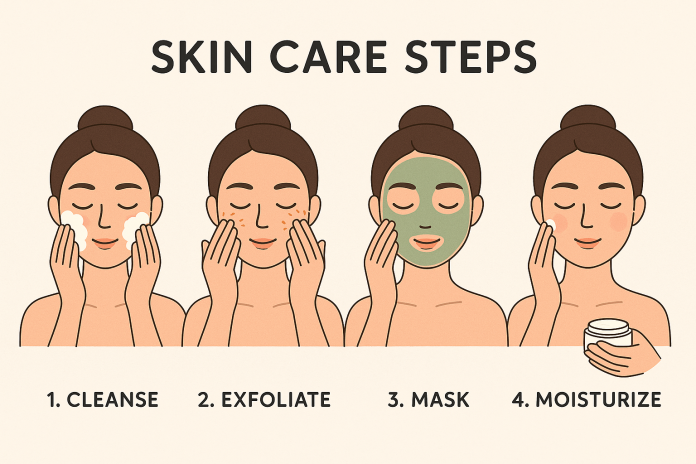
Cleaning is the first and possibly most important step in any skin care regimen. Impurities, excess oil, cosmetics, and pollutants from the environment that accumulate on the skin throughout the day are all eliminated by cleansing. However, cleaning involves striking the correct balance rather than simply scraping everything off. It is essential to use a mild yet efficient cleanser that is appropriate for your skin type. You can be using anything too harsh if, after washing, your skin feels tight and dry. Cleaning without depriving your skin of its natural moisture is the aim. A straightforward procedure may become a calming ritual by using lukewarm water and spending time massaging the cleanser into your skin.
The skin is more prepared to absorb the subsequent steps in your process once it has been cleansed. Toning is frequently used in this situation, albeit its function has changed throughout time. Today’s toners are more sophisticated and frequently contain calming or moisturizing chemicals that balance your skin’s pH and prime it for hydration. Traditionally, toners were thought of as harsh, alcohol-based solutions used to remove residue. Many people describe this phase as a cooling splash that soothes and realigns the skin after cleansing.
It’s time to apply hydration and focused treatment after the skin has been prepped. Serums or essences are important in this situation. Usually lightweight but extremely concentrated, these treatments contain active chemicals that are specifically designed to address issues like pigmentation, fine wrinkles, acne, or dullness. In the morning, a hyaluronic acid serum may deeply hydrate and plump the skin, while a vitamin C serum can assist brighten and shield the skin from environmental damage. A serum containing retinol may be used at night to promote smooth texture and cell turnover. Your regimen can be changed from basic maintenance to proactive care by selecting a serum that meets your demands.
The next step after applying and absorbing your serum is to moisturize. Whether you have dry, oily, mixed, or sensitive skin, moisturizing is crucial. In addition to creating a barrier that keeps moisture from escaping, moisturizers aid in retaining hydration. Additionally, they protect and soothe the skin barrier, which can be weakened by excessive exfoliation or environmental stresses. Gels for oily skin, rich creams for dry skin, and light emulsions for sensitive skin types are among the several textures and compositions available. A straightforward yet efficient method to stay in tune with your skin’s demands is to listen to it and alter your moisturizer as the seasons change.
Perhaps the most crucial part of any afternoon routine is applying sunscreen. UV rays can still enter via windows and damage your skin even if you spend the day indoors or don’t see the sun. Regular use of sunscreen shields your skin from damage that can be hard to repair, lowers your chance of developing skin cancer, and delays the onset of premature aging. It is advised to use a broad-spectrum SPF of at least 30 every day. Sunscreen application should be as natural as brushing your teeth; it should be done carefully and without compromise. As the last layer in your morning routine, it protects your skin, allowing everything underneath it to function normally.
While the morning and nighttime routines are somewhat similar, the latter enables more thorough restoration and repair. Your skin goes into a regenerative condition at night to rebuild its barrier and fix everyday damage. Double washing is a common practice in evening regimens, when makeup and sunscreen are removed with an oil-based cleanser first, and any residue is then removed with a mild water-based cleanser. This two-step method guarantees a fresh start, letting your skin breathe and heal itself over night.
Exfoliation can also be started at night, though it shouldn’t be a daily routine. Exfoliation promotes smoother, more radiant skin by removing dead skin cells and unclogging pores. Physical exfoliants, such as fine-particle scrubs, and chemical exfoliants, such as alpha hydroxy acids (AHAs) and beta hydroxy acids (BHAs), are the two main types. Exfoliation can be quite beneficial when done once or twice a week, but too much of it can weaken the skin’s protective layer and cause discomfort. Exfoliating just enough to regenerate without damaging the skin is crucial.
Another alternative step is applying eye cream, particularly if you have issues with puffiness, dark circles, or fine lines around your eyes. Because of its thinner and more sensitive skin, this area frequently needs softer treatment. Some people choose to forego this step and stick with their usual moisturizer, while others feel that focused eye treatments are beneficial, particularly at specific life phases when the under-eye area is more susceptible to weariness or dehydration.
You can use sheet masks and rinse-off masks as sporadic additions to your routine. After a demanding week, a moisturizing mask can help you regain equilibrium, and a clay mask can help you detox when you have hormonal outbreaks. These treatments are sporadic rituals to supplement your main routine rather than daily steps. They also give you a chance to unwind, block off outside distractions, and just enjoy looking after yourself.
Perhaps the most underappreciated yet effective component of any skin care regimen is consistency. The most important thing is to show up each day with care and attention, regardless of how many stages you include or how costly the products are. Your skin reacts better to love and patience than it does to an overabundance of products motivated by trends. Establishing a routine doesn’t have to be difficult; it can be as easy as three steps or as complex as a complete ritual. It’s important that it feels appropriate for you and sustainable.
Understanding your skin type and seasonal changes enables you to make intelligent adjustments to your routine. Age, environment, stress, and hormones all affect the skin, which is a living, breathing organ. By the time you’re in your forties, your twentysomething routine might have changed. Being self-aware means being adaptable and aware of the way your skin acts. Your skin may require more simplicity or more hydration at different times. A healthy relationship with your body is having faith in your ability to make these decisions.
Your skin care routine is about more than simply appearances; it’s about developing a mindfulness practice, taking care of yourself each day, and finding happiness in small gestures of kindness. These little moments might help you ground yourself and ease the transition between different parts of the day. The simple act of applying lotion at night or the splash of cool water in the morning both have mental and physical benefits.
Ultimately, skin care is not about striving for perfection or adhering to a strict list. It’s about taking care of your skin while honoring its natural cycle. Everything changes when you start to view skin care as an act of wellbeing rather than merely beauty. It turns into a silent form of healing—a gentle yet potent reminder that looking after oneself is essential rather than optional.